Posts

Showing posts with the label fibonacci numbers

Lucas Numbers Day - November 18
Image
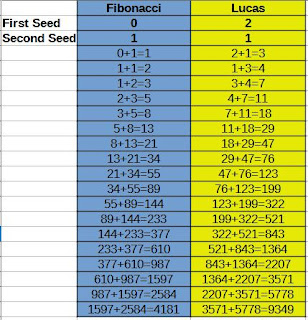
Happy Lucas Numbers Day! If you understand Fibonacci numbers , you'll have no trouble with Lucas numbers . Just like the Fibonacci numbers, the Lucas numbers start with 2 "seed numbers", and every subsequent number is defined as the sum of the preceding 2 numbers. The difference is that while the Fibonacci numbers start with the seed numbers of 0 and 1, the Lucas numbers start with the seed numbers of 2 and 1. This produces a different but similar sequence of numbers. Similar to Fibonacci numbers, Lucas numbers are found in nature. Some sunflower seed patterns eschew the Fibonacci numbers, and use the Lucas numbers instead. Also similar to the Fibonacci numbers, as the numbers get larger, the ratio between consecutive numbers converges on the golden ratio . We celebrate Lucas numbers today because the date, November 18, can be represented as 11/18, the largest consecutive Lucas numbers to form a date.

Tetranacci Numbers Day - August 15

Image
Happy Tetranacci Numbers Day! You may have heard of the  Fibonacci numbers , which starts with 0 and 1, and where every following number is the sum of the previous 2 numbers. Thus Fibonacci numbers are 0, 1, 0+1 = 1, 1+1=2, 1+2=3, 2+3=5, 3+5=8, ... Mathematicians quickly noticed that they could define a variety of similar sets of numbers by changing the rules slightly. One variation are the  Tetranacci numbers  (named by merging the tetra- suffix with much of the original Fibonacci name). The Tetranacci numbers start with the "seed numbers" of 0, 1, 1, and 1, and each of the following numbers are the sum of the previous 3 numbers. Thus we get numbers of 0 , 0 , 0 , 1 , 0+0+0+1= 1 , 0+0+1+1= 2 , 0+1+1+2= 4 , 1+1+2+4= 8 , 1+2+4+8= 16 , ... While the Fibonacci numbers are known to show up in nature, the Tetranacci numbers are mostly of interest to mathematicians alone. We celebrate Tetranacci numbers on 8/15 because those are the largest sequential Tetranacci numbers that re...

Fibonacci Numbers Day - August 13

Image
It's Fibonacci Numbers Day. Fibonacci numbers are the numbers that start with 0 and 1, and each subsequent number is the sum of the 2 preceding numbers: 0 , 1 , 0+1= 1 , 1+1= 2 , 1+2= 3 , 2+3= 5 , 3+5= 8 , 5+8= 13 , 8+13= 21 , ... Though the sequence was known to Indian mathematicians as far back as 200 BC, it wasn't known in Europe until introduced by the Italian mathematician Fibonacci in the 13th century. This simple sequence has a surprising amount of utility in math, nature, and related fields. It's also got ties to the golden ratio , which used to be considered to define the perfect rectangle. We celebrate Fibonacci numbers on 8/13 because those are the largest sequential Fibonacci numbers that represent a (Gregorian calendar) date. Jahobr, CC0, via Wikimedia Commons

Tribonacci Numbers Day - July 13

Image
You may have heard of the Fibonacci numbers , which starts with 0 and 1, and where every following number is the sum of the previous 2 numbers. Thus Fibonacci numbers are 0, 1, 0+1 = 1, 1+1=2, 1+2=3, 2+3=5, 3+5=8, ... Mathematicians quickly noticed that they could define a variety of similar sets of numbers by changing the rules slightly. Perhaps the next easiest to deal with are the Tribonacci numbers (named by merging the tri- suffix with much of the original Fibonacci name). The Tribonacci numbers start with the "seed numbers" of 0, 1, and 1, and each of the following numbers are the sum of the previous 3 numbers. Thus we get numbers of 0, 0, 1, 0+0+1 = 1, 0+1+1=2, 1+1+2=4, 1+2+4=7, ... While the Fibonacci numbers are known to show up in nature, the Tribonacci numbers are mostly of interest to mathematicians alone. (The ratio between adjacent Tribonacci numbers - the Tribonacci constant - is used in calculations involving the snub cube .) We celebrate Tribonacci numbers o...