Posts

Showing posts with the label math

Look and Say Day - December 11
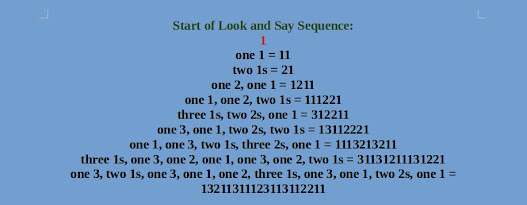
Image
Happy Look and Say Day! It celebrates an especially tricky sequence of numbers, the Look and Say Sequence. Look and Say Day is about the following sequence of numbers: 1 11 21 1211 111221 312211 13112221 etc Simply seeing this sequence, the average person probably wouldn't figure out the next numbers (1113213211 and 31131211131221, FWIW) ... but since I told you this is Look and Say Day, you may have already figured it out. Starting with a "seed number" of 1, each subsequent number is basically the pronunciation of like digits: 1 (one 1) 11 (two 1s) 21  (one 2, two 1s) 1211  (one 1, one 2, two 1s) 111221 (three 1s, two 2s, one 1) 312211 This turns out to be a fairly easy (if lengthy) sequence to derive. (It might be one of those puzzles that a child is more likely to resolve than an adult, since they'll spend less time going down incorrect paths.) There's a video on the Look and Say Sequence here . We celebrate Look and Say Day on December 11 (or 12/11) because 12...

Telephone Numbers Day - October 26

Image
Happy Telephone Numbers Day! You may be surprised to learn that these aren't the telephone numbers associated with our individual telephones, but instead represent the number of ways that n number of telephones can be connected to each other for 2-way calls. For example, if you have 0 phones or 1 phone, there only 2-way "connection" possible is no connection at all. But if you have 2 phones, there are now 2 possibilities: no connection at all or the 2 phones connected to each other. This table shows the number of combinations possible when you have very few phones: You might notice that the number of combinations starts very small but then grows pretty quickly. This is one reason why it's impractical to set up a telephone network with equipment dedicated to every possible phone call combination. Actually writing and counting all those combinations would get tedious pretty quickly; fortunately there's a formula for that: Applying this formula, you can see just how...

Tetranacci Numbers Day - August 15

Image
Happy Tetranacci Numbers Day! You may have heard of the  Fibonacci numbers , which starts with 0 and 1, and where every following number is the sum of the previous 2 numbers. Thus Fibonacci numbers are 0, 1, 0+1 = 1, 1+1=2, 1+2=3, 2+3=5, 3+5=8, ... Mathematicians quickly noticed that they could define a variety of similar sets of numbers by changing the rules slightly. One variation are the  Tetranacci numbers  (named by merging the tetra- suffix with much of the original Fibonacci name). The Tetranacci numbers start with the "seed numbers" of 0, 1, 1, and 1, and each of the following numbers are the sum of the previous 3 numbers. Thus we get numbers of 0 , 0 , 0 , 1 , 0+0+0+1= 1 , 0+0+1+1= 2 , 0+1+1+2= 4 , 1+1+2+4= 8 , 1+2+4+8= 16 , ... While the Fibonacci numbers are known to show up in nature, the Tetranacci numbers are mostly of interest to mathematicians alone. We celebrate Tetranacci numbers on 8/15 because those are the largest sequential Tetranacci numbers that re...