Posts

Showing posts with the label public key cryptography

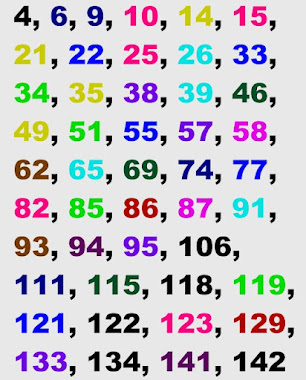
Semiprime Numbers Day - October 14
Image
Happy Semiprime Numbers Day! Semiprime numbers are the product of exactly 2 prime numbers , so 4 (2 X 2) and 6 (2 X 3) are semiprimes, but 8 (2 X 2 X 2) and 30 (2 X 3 X 5) are not. More examples are here: Public key cryptography depends on the difficulty of factoring very large semiprime numbers for its effectiveness. Semiprime Numbers Day is celebrated on the date 10/14, or October 14, since 10 and 14 are the largest consecutive semiprime numbers forming a valid date.

Composite Numbers Day - December 14

Image
Happy Composite Numbers Day! Composite numbers are sort of like the complement of the prime numbers (ignoring 1, which is neither), and each of them can be expressed as two or more prime numbers. For example, 12 = 2 X 2 X 3 (2 and 3 are primes) so it is composite, and 35 = 5 X 7 (5 and 7 are primes) so it is composite. Every positive integer greater than 1 is going to be either a prime number or a composite number. A subset of the composite numbers, the semiprime numbers , are the driving force behind  public key cryptography  Other interesting subsets of the composite numbers are the sphenic numbers and the powerful numbers . December 14 was chosen for Composite Numbers Day since they are the largest consecutive composite numbers to form a date: 12/14.